
If you run a cleaning company in the UK, you already know that the quality of your work is not the problem. Your team is reliable, your results are good and your existing clients are happy. The problem is that not enough of the right people know you exist.
Marketing a cleaning company is genuinely difficult. Not because the principles are complicated but because most of the advice available online was written for American markets, treats all cleaning businesses as identical or gives generic digital marketing guidance that does not account for how cleaning company clients actually search for and choose a provider.
This guide is written specifically for UK cleaning company owners. It covers the channels that actually work, the strategies that consistently generate enquiries and the mistakes that waste budget without producing results. Whether you run a domestic cleaning business, a commercial contract cleaning operation or a specialist cleaning service, the principles in this guide apply to your business.
If you would rather have someone do this for you, our cleaning company marketing page explains how we work with cleaning businesses specifically.
Why marketing matters more than ever for cleaning companies
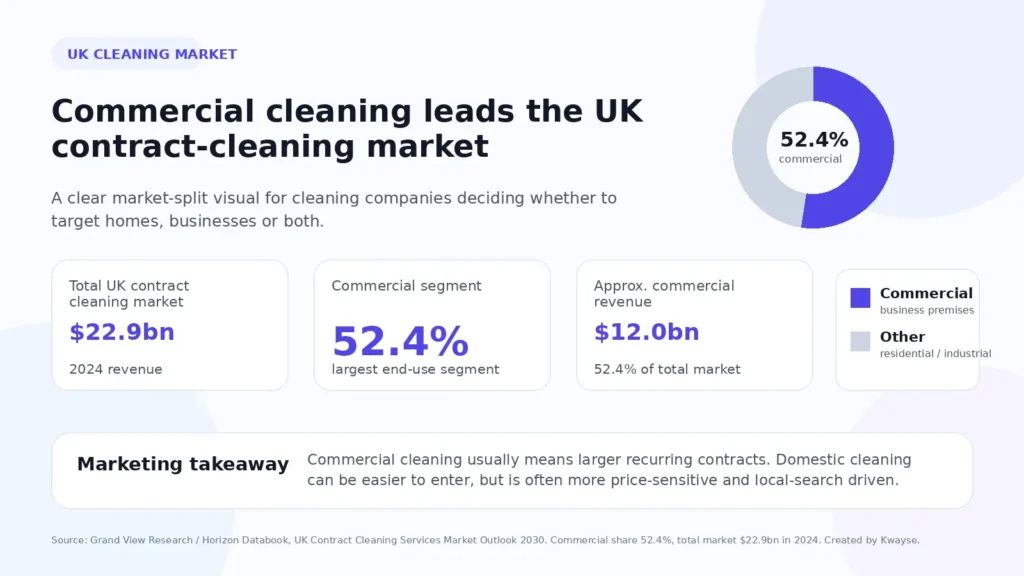
The UK cleaning industry employs around 700,000 people and generates billions in revenue each year. According to the British Cleaning Council, the sector is one of the largest employers in the country, with demand consistently growing across both domestic and commercial segments.
That growth creates opportunity but it also creates competition. The number of cleaning companies operating in most UK towns has increased significantly over the past decade. In many areas, a business owner searching for a commercial cleaning contract or a homeowner looking for a regular domestic cleaner has dozens of options to choose from.
The businesses that win in this environment are not always the ones doing the best work. They are the ones that are most visible, most credible and easiest to engage with online. That is the core argument for investing in marketing as a cleaning company. Your service might be excellent but if your online presence does not reflect that quality, you will lose clients to competitors who are not as good as you but who are better at being found.
The businesses that rely entirely on referrals for growth are at a permanent disadvantage. Referrals are valuable but they are unpredictable, slow and entirely dependent on other people’s activity. A properly built marketing system gives you a lever you can pull whenever you need more clients.
The foundation: your website
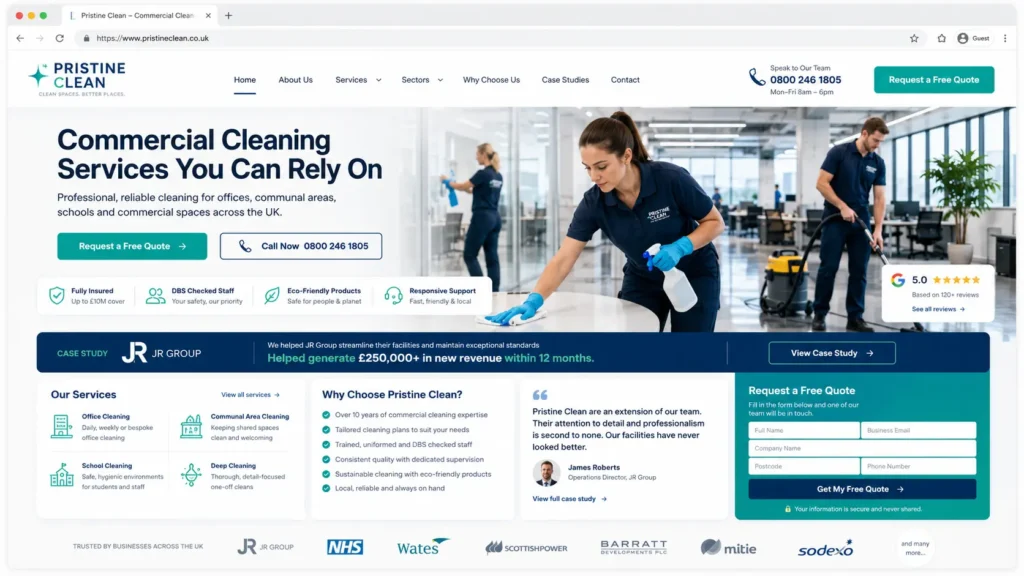
Before spending a single pound on any form of marketing, your website needs to be working properly. This is the single most important principle in cleaning company marketing and the one that most businesses get wrong.
Most cleaning company websites fail to convert visitors for the same reasons. They were built by a web designer who focused on how the site looks rather than how it performs. The result is a website that looks acceptable but does not turn visitors into enquiries.
Here is what a cleaning company website needs to do well.
Build trust immediately. A visitor who lands on your cleaning company website has a simple question: can I trust these people to come into my home or my business premises? Your website needs to answer that question within the first few seconds. Professional photography, Google reviews prominently displayed, accreditations and case studies all contribute to that trust signal.
Make the next step obvious. Whether you want visitors to call you, fill in a quote request form or book a consultation, that action needs to be front and centre on every page. A cleaning company website that buries the contact information or makes the enquiry process unclear will lose the majority of its visitors without them ever getting in touch.
Load fast on mobile. According to Think with Google, the majority of local service searches happen on mobile devices. A cleaning company website that loads slowly or is difficult to navigate on a phone is losing enquiries every single day. Page speed is also a ranking factor for Google, so a slow website hurts your SEO as well as your conversion rate.
Be specific about what you offer and where. Generic cleaning company websites that do not specify service types, coverage areas or client types make it harder for Google to rank them and harder for visitors to self-qualify. A page specifically about commercial office cleaning in Manchester will outperform a generic cleaning services page for someone searching for exactly that.
Have a clear quote or enquiry process. The easier you make it to request a quote, the more quotes you will receive. A simple, short form asking for name, contact details, service type and rough frequency is sufficient. Do not ask for more information than you need at this stage.
SEO for cleaning companies: getting found on Google
Search engine optimisation is the highest-return long-term marketing channel for most cleaning companies. When a facilities manager searches for “commercial cleaning company Manchester” or a homeowner searches for “domestic cleaning Guildford”, appearing on the first page of Google puts your business in front of a customer with an active, immediate need.
The challenge is that SEO takes time. Most cleaning companies start seeing meaningful results within three to six months of a well-executed strategy. That timeline puts many business owners off. They want results faster and turn to paid advertising instead. The businesses that invest in SEO patiently and consistently are the ones that eventually have the most stable and cost-effective client acquisition channel in their market.
Here is what SEO for a cleaning company involves.
Google Business Profile optimisation
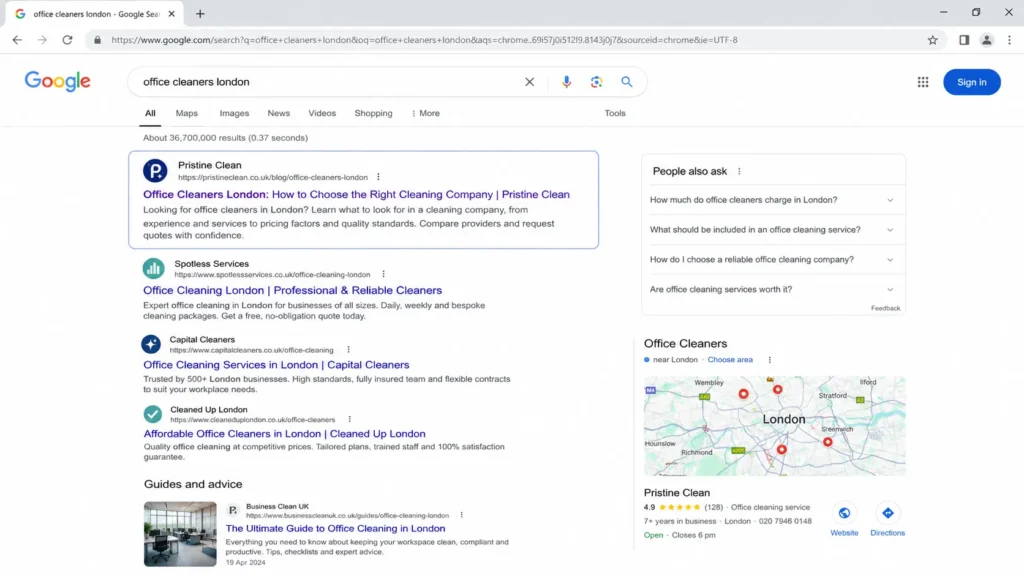
Your Google Business Profile is arguably the most important single asset in your local SEO strategy. When someone searches for a cleaning company in your area, the Google map pack, which is the block of three business listings that appears near the top of local search results, drives a significant proportion of enquiries.
To appear in the map pack you need a fully optimised Google Business Profile. This means accurate and complete business information, a strong and consistent set of Google reviews, regular posts and updates, photos of your team and work and responses to every review whether positive or negative.
Getting reviews should be a systematic part of your client relationship process. After every successful job or at regular intervals with ongoing clients, ask for a Google review. Most satisfied clients will leave one if asked directly and at the right moment.
Location pages
If your cleaning company serves multiple areas, you need dedicated pages for each location. A page titled “Commercial Cleaning London” and a page titled “Commercial Cleaning Birmingham” will each rank for searches in their respective areas far more effectively than a single generic page trying to cover both.
These location pages need to be genuinely useful rather than thin, templated content. They should reference the specific area, explain your coverage and service offering for that location and include locally relevant trust signals such as case studies or testimonials from clients in that area.
Service-specific pages
The same principle applies to service types. A page specifically about end of tenancy cleaning will rank for end of tenancy cleaning searches. A page about office cleaning will rank for office cleaning searches. A single page trying to cover every service type will struggle to rank for any of them.
Map out the cleaning services you offer and create a dedicated, well-written page for each one. Each page should clearly describe the service, explain your process, answer the most common questions clients ask and include a clear call to action.
Building local authority
Google determines local search rankings based on three factors: relevance, distance and prominence. Prominence is built through a combination of Google reviews, consistent mentions of your business name and address across the web (known as citations) and links from other reputable local websites.
Building local citations means ensuring your business is listed accurately and consistently on directories including Yell, Thomson Local, Checkatrade, Trustpilot and industry-specific directories relevant to the cleaning sector. Consistency matters here. Your business name, address and phone number should be identical across every listing.
Google Ads for cleaning companies
While SEO builds long-term visibility, Google Ads can generate enquiries within days of launching a campaign. For cleaning companies that need faster results, or that want to supplement organic traffic with paid visibility, Google Ads is the most effective paid channel available.
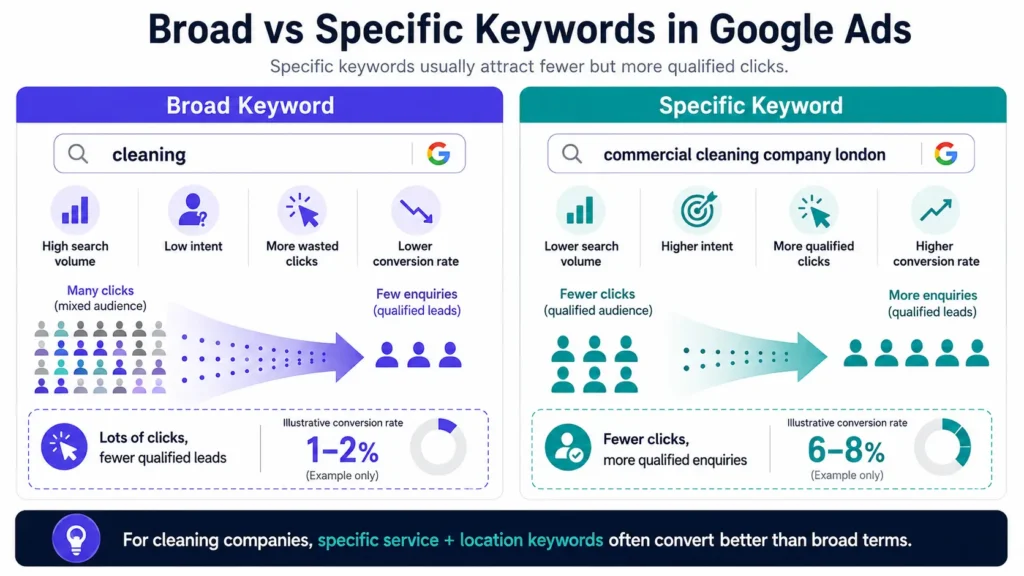
The key difference between Google Ads that work and Google Ads that waste money is the specificity of the targeting and the quality of the landing page.
What makes a cleaning company Google Ads campaign work
Targeting the right keywords. Broad, general terms like “cleaning company” will generate clicks from people who are not your ideal client. Specific terms like “commercial cleaning contract London” or “office cleaning services Manchester” attract people with a clear and immediate intent to find exactly what you offer.
Writing ads that filter as well as attract. Your ad copy should be specific enough that someone who is not a good fit for your service does not click on it. Mentioning your minimum contract size, your geographic coverage or the specific service type helps qualify traffic before it reaches your website.
Sending traffic to a dedicated landing page. Sending paid traffic to your homepage is one of the most common and expensive mistakes in Google Ads management. A visitor who clicked on an ad for office cleaning services should land on a page specifically about office cleaning services, not a general cleaning company homepage where they have to go looking for the relevant information.
Tracking conversions properly. Without accurate conversion tracking you cannot tell which keywords, ads and campaigns are generating enquiries and which are just spending budget. Setting up call tracking and form submission tracking before launching any campaign is essential.
What budget do you need for Google Ads?
Google Ads for cleaning companies in the UK typically requires a minimum of £1,000 per month in ad spend to generate meaningful data and results. In competitive markets like London, Birmingham and Manchester that figure may need to be higher.
The return on that investment varies depending on your average contract value and conversion rate. A commercial cleaning company winning contracts worth thousands of pounds per year from a well-run Google Ads campaign can see very strong returns on a modest ad spend.
The difference between domestic and commercial cleaning marketing
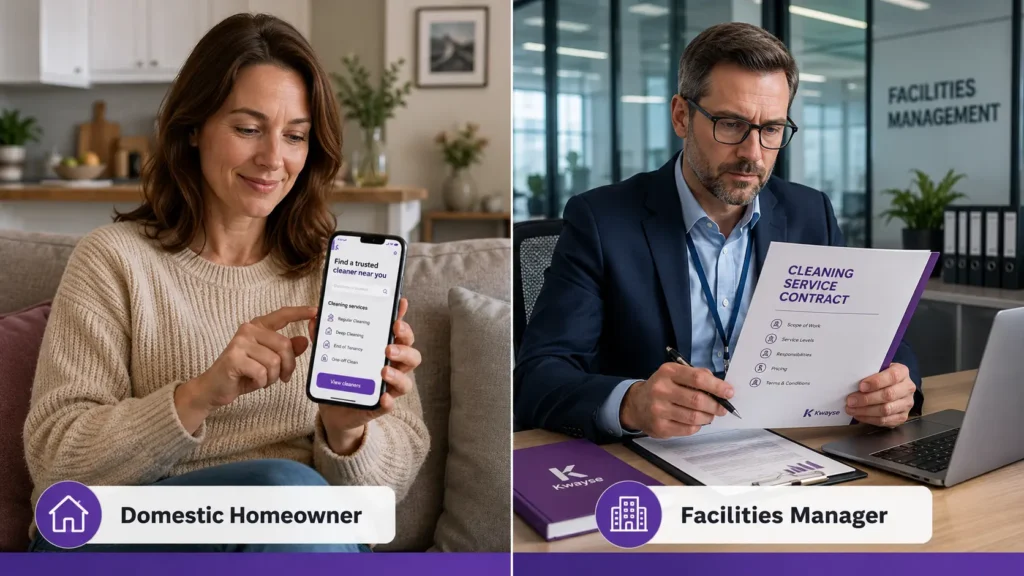
One of the most important decisions in cleaning company marketing is understanding that domestic and commercial cleaning clients behave very differently and need to be marketed to in different ways.
Domestic cleaning clients are typically individuals or households. They search on Google, read reviews, compare prices and make relatively fast decisions. They care about trust, reliability and value. They are often found through local SEO, Google map pack visibility and Google Ads targeting residential cleaning searches.
Commercial cleaning clients, particularly for larger contracts, have a longer and more considered buying process. A facilities manager looking for a commercial cleaning contract for a large office building is not going to make a decision based on a quick Google search and a handful of reviews. They will request multiple quotes, check accreditations, ask for references and assess your ability to manage a contract at scale.
This means that marketing a commercial cleaning company requires a stronger emphasis on credibility signals. Professional accreditations such as British Institute of Cleaning Science (BICSc) membership, ISO certifications and Safe Contractor approval all matter to commercial clients in a way they do not to domestic clients.
Your website and marketing materials for commercial clients should lead with your ability to manage contracts, your staff vetting processes, your insurance levels and your track record with comparable clients. Specific case studies showing the type of building, the service provided and the outcome are far more persuasive to a commercial client than generic claims about quality.
Reviews and reputation management
For cleaning companies, online reviews are not a nice-to-have. They are a primary trust signal that directly influences whether potential clients choose you or a competitor.
A cleaning company with 50 Google reviews averaging 4.8 stars will consistently win more enquiries than a competitor with a better service but only 8 reviews. That is the reality of how people make decisions about service businesses online.
Here is how to build and manage your cleaning company’s online reputation systematically.
Ask every client for a review after a positive job. The best moment to ask is immediately after the client has expressed satisfaction, when the positive experience is fresh. A simple follow-up text or email with a direct link to your Google review page makes the process frictionless.
Respond to every review. Responding to positive reviews shows engagement and gratitude. Responding to negative reviews, when handled well, can actually increase trust by demonstrating that you take feedback seriously and resolve issues professionally.
Do not ignore negative reviews. A cleaning company with 100 positive reviews and 2 negative reviews, both of which have been responded to professionally, will be trusted more than a company with 30 reviews and nothing negative because potential clients know the negative reviews have not been filtered or hidden.
Build reviews across multiple platforms. While Google reviews are the most valuable for local SEO, reviews on Trustpilot, Checkatrade and Facebook all contribute to your overall online reputation. Having a strong presence across multiple platforms reduces your dependency on any single one.
Social media for cleaning companies
Social media is often the first marketing channel cleaning company owners turn to and frequently the one that delivers the least return for the time invested. That is not because social media cannot work for cleaning companies. It is because most cleaning businesses use it incorrectly.
The mistake is treating social media as a sales channel and posting a constant stream of promotional content. Nobody follows a cleaning company on Instagram because they want to see offers and special deals. They follow cleaning content because it is satisfying, aspirational or useful.
What actually works on social media for cleaning companies
Before and after content performs consistently well. A short video or photo series showing a heavily soiled carpet transformed by a professional clean, or a commercial kitchen brought back to spotless condition, generates genuine engagement because the transformation is visually compelling.
Behind the scenes content builds trust. Short videos of your team working, your equipment being maintained, your cleaning products being prepared or your van being loaded for the day humanise your business and build familiarity with potential clients.
Educational content attracts future clients. Tips on maintaining a clean home between professional cleans, how to choose a cleaning company or what to look for in a commercial cleaning contract position you as an expert and attract people who are in the early stages of looking for a service.
Client testimonials and reviews shared on social media reinforce trust and give social proof in a format that is native to the platform.
For most cleaning companies, Instagram and Facebook are the most relevant platforms for domestic clients while LinkedIn is worth investing in if you are targeting commercial and facilities management clients.
Content marketing and blogging
A cleaning company blog might not be the first thing that comes to mind when thinking about how to grow your business, but content marketing is one of the most cost-effective ways to build organic traffic and establish your cleaning company as a credible authority in your market.
The principle is straightforward. When a potential client searches for an answer to a question about cleaning, whether that is “how often should office carpets be professionally cleaned” or “what is included in an end of tenancy clean”, your blog article answering that question is how they find your website.
Every article that ranks for a relevant search term is a permanent, compounding source of traffic. Unlike paid advertising which stops the moment you stop paying, a well-ranked blog article keeps generating visitors for months and years after it was written.
The topics that perform best for cleaning company blogs in the UK include:
Guides to specific cleaning tasks such as carpet cleaning, oven cleaning, end of tenancy cleaning and commercial kitchen cleaning.
Comparisons such as the difference between domestic and commercial cleaning contracts, or how to evaluate cleaning company quotes.
Locally relevant content such as the best cleaning companies in a specific city, or a guide to commercial cleaning regulations for UK businesses.
Industry and compliance content aimed at facilities managers and commercial clients, covering topics like COSHH regulations, cleaning product safety and environmental cleaning standards.
Measuring what is working
One of the most common problems in cleaning company marketing is spending money without knowing what is generating results. Many cleaning business owners run a website, do some social media, spend on Google Ads and have no clear picture of which of those activities is actually responsible for the enquiries they receive.
Getting this right does not require complicated technology. It requires a few basic tracking tools used consistently.
Google Analytics shows you how many people are visiting your website, where they came from and what they did once they arrived. Setting it up on your cleaning company website takes less than an hour and gives you the data you need to make informed decisions about where to focus your marketing investment.
Google Search Console shows you which search terms people are using to find your website. This tells you whether your SEO is working and which keywords are driving the most relevant traffic.
Asking every new enquiry how they found you is the simplest and most underused data collection method available. A field on your enquiry form asking “how did you hear about us?” takes two minutes to add and generates invaluable information about which channels are producing results in your specific market.
Call tracking numbers, where a unique phone number is displayed to visitors from specific channels, allow you to attribute phone enquiries to the marketing source that generated them. For cleaning companies where many enquiries come via phone rather than form submission, this is particularly valuable.
Putting it all together: a realistic marketing plan for a UK cleaning company
The most effective cleaning company marketing is not about doing everything at once. It is about building the right foundation and then adding channels systematically as each one is working.
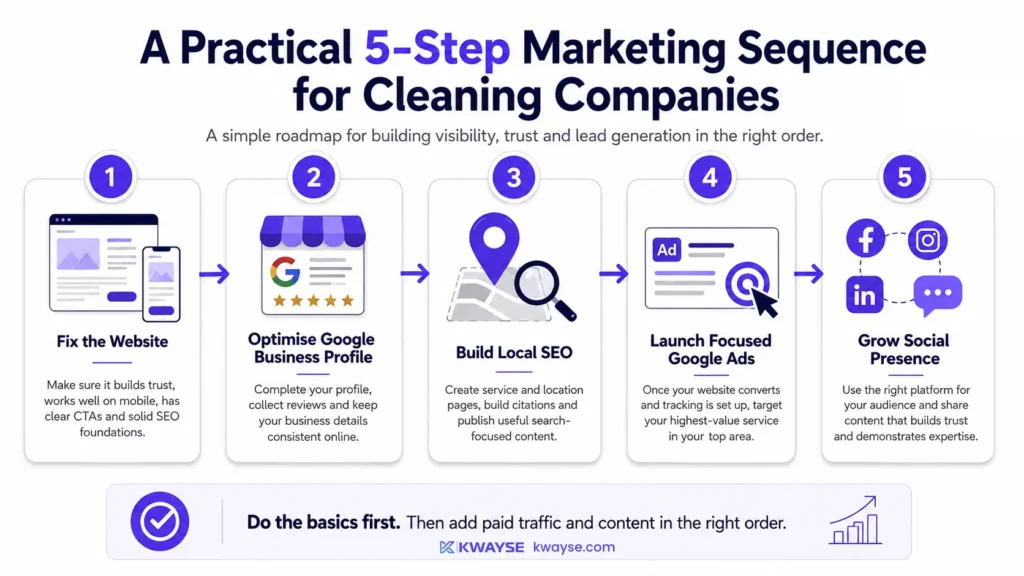
Here is a practical sequence for a cleaning company that is starting to invest properly in marketing.
First, fix the website. Before spending money on any traffic channel, ensure your website builds trust, is fast on mobile, has clear calls to action and has basic SEO foundations in place. A website that does not convert will waste every pound spent on driving traffic to it.
Second, claim and optimise your Google Business Profile. This is free and directly affects your visibility in local searches. Get your profile fully complete, start collecting Google reviews systematically and make sure your business information is consistent everywhere it appears online.
Third, build your local SEO. Create service-specific and location-specific pages on your website. Build citations on relevant directories. Start producing content that answers the questions your ideal clients are asking on Google.
Fourth, consider Google Ads for faster results. Once your website is converting and your tracking is set up, Google Ads can accelerate your lead generation significantly. Start with a focused campaign targeting your highest-value service in your most important geographic area.
Fifth, build your social media presence in line with your audience. For domestic cleaning, Instagram and Facebook. For commercial cleaning, LinkedIn. Focus on content that demonstrates expertise and builds trust rather than content that promotes and sells.
The businesses that execute this sequence consistently and patiently are the ones that build genuinely sustainable, scalable marketing systems. The cleaning companies that generate the most consistent growth are not the ones spending the most. They are the ones spending in the right places on the right foundations.
Real results: what effective cleaning company marketing can deliver
Theory is useful. Real results are more persuasive.
JR Group is a commercial cleaning company that came to Kwayse with a strong service and almost no meaningful online presence. Their new business came almost entirely through referrals. Their website was not ranking for any relevant search terms and was not converting the visitors it did receive.
Kwayse rebuilt their website around the decision-making process of commercial cleaning clients, developed an SEO strategy targeting the commercial cleaning search terms their ideal clients were using and built local visibility across their target geographic areas.
Within the first few months, JR Group had generated around £50,000 in new revenue directly traceable to their improved online presence. Within 12 months that figure had exceeded £250,000+.
That is what a properly built cleaning company marketing system delivers. Not overnight results, not magic, but consistent, compounding growth from a website and SEO strategy that works.
Read more about how we approach cleaning company marketing and what results it has delivered for UK cleaning businesses.
Conclusion
Marketing a cleaning company in the UK successfully comes down to a small number of principles applied consistently.
Your website needs to convert. Your Google visibility needs to reflect the quality of your service. Your reviews need to build trust before a potential client has even spoken to you. And your paid advertising, if you use it, needs to be targeted, tracked and built around conversion rather than clicks.
The cleaning companies that invest in getting these fundamentals right consistently outperform competitors who rely on referrals, try everything at once without measuring anything or spend money on marketing channels that are not suited to how cleaning company clients actually make decisions.
If your cleaning business is ready to build a more predictable, more scalable source of new clients, the foundations described in this guide are where to start.
If you would like help putting any of this into practice, our cleaning company marketing service is built specifically for businesses like yours.

